Aerial view of Brazilian Amazon rivers weaving through forest, highlighting ecological complexity and governance challen
Updated: March 16, 2026
brazil Environment Brazil is at a policy crossroads as governance decisions around river management, land use, and climate adaptation intersect with Indigenous rights and a rapidly warming climate. This analysis for ecobrazilinitiative.org traces how decisions made today will shape ecological resilience, livelihoods, and democratic oversight across Brazil’s vast biomes and urban centers alike.
River governance and privatization reversal
In the Amazon, a government move to privatize three major rivers drew sustained protests from Indigenous communities, environmentalists, and local stakeholders. After weeks of mobilization and reviews, officials canceled or rolled back the concession plan, signaling a pause in attempts to privatize essential watershed resources. The reversal foregrounds how resource governance is negotiated among the state, private interests, and the communities most affected by river flows and water rights. It also raises questions about the design of concessions, the adequacy of public oversight, and the durability of environmental safeguards when private operators would manage navigation, irrigation, or hydropower interfaces.
Policy designers now face a dilemma: how to attract investment and modernization without surrendering public stewardship or Indigenous sovereignty. Critics warn that even temporary privatization experiments can set precedents that shift negotiation power away from communities and toward balance sheets. Proponents, meanwhile, argue that well-structured concessions, transparent monitoring, and performance-based conditions could unlock capital needed for watershed restoration and infrastructure. The current reversal therefore becomes a test case for how Brazil balances growth, rights, and ecological integrity in a region where both opportunity and risk are amplified by scale.
Climate risk and flood resilience
Brazilian authorities and researchers have repeatedly highlighted climate-driven extremes as a growing policy driver. Recent flood episodes have exacted a human and economic toll, with fatalities and missing persons prompting urgency around warning networks, land-use planning, and resilient infrastructure. The situation is not simply a weather anomaly: it reflects the interaction of heavier rainfall events with land-use patterns, deforestation pressures, and urban expansion along river basins. Building resilience thus requires a multi-layered approach—early warning and evacuation planning for vulnerable communities, investments in drainage and flood-control infrastructure, and incentives for nature-based solutions that reduce runoff and safeguard critical habitats.
Concrete steps include allocating dedicated funds for disaster risk reduction, strengthening cross-jurisdictional data-sharing, and integrating climate projections into municipal planning. The broader climate context suggests that single-sector fixes will be insufficient; instead, Brazil must fuse environmental stewardship with urban design, social protection, and economic diversification to reduce vulnerability across coastal, riverine, and inland communities.
Agriculture and the green transition
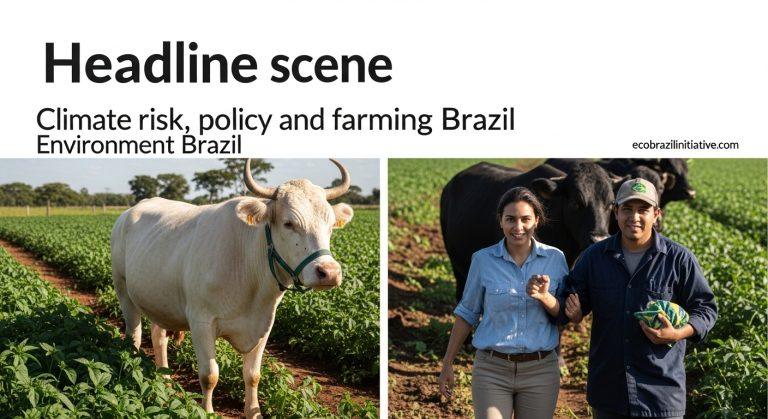
Brazilian soy farmers and supply chains are increasingly under global scrutiny to demonstrate credible climate stewardship. Across farms and regions, pilots and programs are testing green practices such as cover cropping, reduced tillage, nutrient-smart fertilization, and integrated pest management. These innovations aim to lower emissions, protect soil health, and preserve forested landscapes while maintaining productivity. The challenge lies in scaling up successful pilots, aligning incentives with market demand, and ensuring that sustainability commitments translate into verifiable outcomes rather than greenwashing. Market signals—from export markets to consumer campaigns—are pushing producers toward deforestation-free supply chains, but enforcement, traceability, and independent verification remain critical gaps that Brazil must close to realize a genuinely green agricultural transition.
Policy tools such as carbon accounting, reward schemes for regenerative practices, and transparent supply-chain disclosures can help align economic and environmental objectives. At the same time, farmers argue for policy certainty, accessible financing, and technical support to invest in long-term soil and ecosystem health. The path forward will depend on credible governance that links agribusiness success with measurable environmental and social gains, rather than trade-offs imposed by short-term markets.
Indigenous rights, governance, and policy coherence
Effective environmental governance in Brazil hinges on recognizing Indigenous tenure and knowledge as central to landscape stewardship. Policy coherence across ministries—environment, agriculture, energy, and justice—matters as decisions about land allocation, river use, and resource extraction reverberate through communities that rely on intact ecosystems for sustenance, culture, and livelihoods. The current moment invites a recalibration toward inclusive decision-making, co-management models, and robust free, prior, and informed consent processes. When Indigenous voices shape rulemaking, protections for riverine and forested systems are more likely to be enforced, monitored, and sustained, reducing the risk of extralegal or rapid shifts in policy that undermine trust and long-term resilience.
There is also a need to strengthen civil society and independent watchdog capacity to track outcomes, verify compliance, and illuminate trade-offs. Policy coherence does not guarantee perfect results, but it does raise the probability that environmental gains, social equity, and economic opportunity can advance in tandem rather than at cross-purposes. In practice, this means formalizing multi-stakeholder platforms, clarifying responsibilities across agencies, and investing in participatory governance that treats ecological health as a collective public good.
Actionable Takeaways
- Strengthen public oversight of river concessions and prohibit privatization without meaningful Indigenous consultation and transparent impact assessments.
- Invest in flood risk reduction—early warning systems, resilient infrastructure, and nature-based solutions—especially for vulnerable communities near major basins.
- Scale credible green farming practices through financing, technical assistance, and verifiable supply-chain standards that link productivity with environmental outcomes.
- Align policies across ministries to ensure Indigenous rights, forest protection, and climate commitments reinforce one another rather than producing conflicting mandates.
- Support independent monitoring and public dashboards to track river health, deforestation trends, and soil carbon changes to enable accountability and informed decisions.