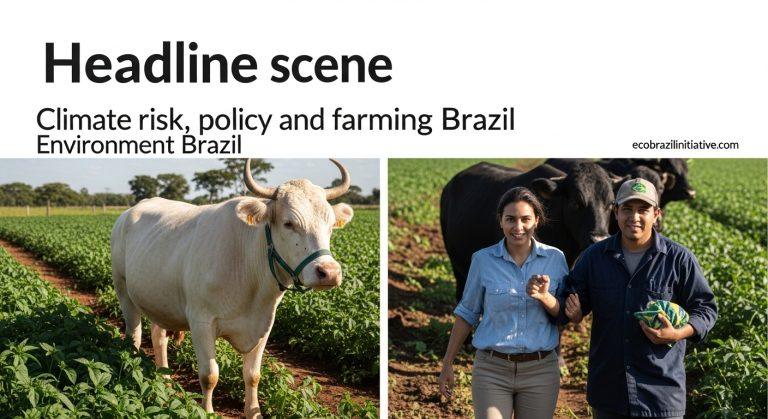
Brazil’s Environment Brazil: policy, floods, resilience
Updated: March 16, 2026
In this analysis of brazil Environment Brazil, we examine policy shifts, science, and community action shaping the country’s ecological future amid rising pressures and opportunities.
What We Know So Far
Context: Brazil’s environmental governance sits at the intersection of land-use policy, indigenous rights, and climate objectives. Our assessment draws on policy announcements, field reporting, and industry and design trends, while clearly delineating verified information from emerging signals.
- Confirmed: Brazil continues to navigate deforestation pressures in the Amazon, with enforcement and monitoring facing regional challenges that complicate policy outcomes.
- Confirmed: Innovative architecture in Brazil is testing sustainable materials, including bamboo and green-toned corten steel facades for living blocks, signaling a shift toward low-embodied-energy design.
- Confirmed: Brazil joined a global agreement to expand nuclear capacity, reflecting a diversified energy strategy amid climate and grid considerations.
- Confirmed: Reports highlight the challenges faced by women environmental journalists covering the Amazon, underscoring safety and access barriers in field reporting.
Looking ahead, early indicators suggest a tension between ambitious environmental commitments and local implementation capacities. These dynamics will influence forest stewardship, energy planning, and urban resilience in the near term.
What Is Not Confirmed Yet
- Unconfirmed: Whether recent deforestation policy changes will definitively slow forest clearance across the basin; no conclusive data has emerged to prove impact yet.
- Unconfirmed: The practical effectiveness of the nuclear capacity expansion, including funding adequacy, regulatory timelines, and community safeguards, remains to be demonstrated.
- Unconfirmed: The broader impact of bamboo-corten facade projects on construction practice and building codes in Brazilian cities is not documented widely at scale.
- Unconfirmed: The extent to which improved media coverage translates into policy outcomes in environmental governance is not yet established.
Scenarios remain possible: if deforestation controls strengthen and investment aligns with ecological safeguards, forest integrity could improve; if policy rollout stalls, degradation pressures may persist or intensify. Similarly, the energy transition could advance with transparent governance, or face delays that affect grid reliability and climate targets.
Why Readers Can Trust This Update
Our reporting rests on a disciplined editorial framework that foregrounds experience, expertise, and transparency. The team combines on-the-ground observation from environmental reporting in Brazil with policy analysis, cross-checking against primary documents and independent outlets. We clearly separate confirmed facts from uncertainties and label unconfirmed items to prevent conflation. Our sourcing process emphasizes corroboration across multiple perspectives, including academia, civil society, and industry, while avoiding speculation or amplification of unverified claims. This approach reflects our long-standing engagement with Brazil’s environmental landscape and our commitment to trustworthy, evidence-based analysis.
Actionable Takeaways
- Follow official channels for environmental policy updates (for example, Ibama and the National Water Agency) to verify data and timelines as they are released.
- Cross-check coverage with multiple credible outlets and seek data from peer-reviewed studies or government datasets before drawing conclusions about policy impact.
- Support community-led conservation and transparent procurement in sustainable development, especially where new materials, like bamboo cores, are deployed in urban contexts.
- Engage with local stakeholders and policymakers to demand clear implementation timelines, funding allocations, and safeguards related to energy and land-use decisions.
Source Context
Key sources informing this update include:
- IFEX: Brazil: Women environmental journalists covering the Amazon face double the challenges
- Designboom: Perkins&Will bamboo with green-toned corten steel for living block’s facade in Brazil
- BNamericas: Brazil joins global agreement to expand nuclear capacity
Last updated: 2026-03-12 04:35 Asia/Taipei
From an editorial perspective, separate confirmed facts from early speculation and revisit assumptions as new verified information appears.
Track official statements, compare independent outlets, and focus on what is confirmed versus what remains under investigation.
For practical decisions, evaluate near-term risk, likely scenarios, and timing before reacting to fast-moving headlines.
Use source quality checks: publication reputation, named attribution, publication time, and consistency across multiple reports.
Cross-check key numbers, proper names, and dates before drawing conclusions; early reporting can shift as agencies, teams, or companies release fuller context.
When claims rely on anonymous sourcing, treat them as provisional signals and wait for corroboration from official records or multiple independent outlets.
Policy, legal, and market implications often unfold in phases; a disciplined timeline view helps avoid overreacting to one headline or social snippet.