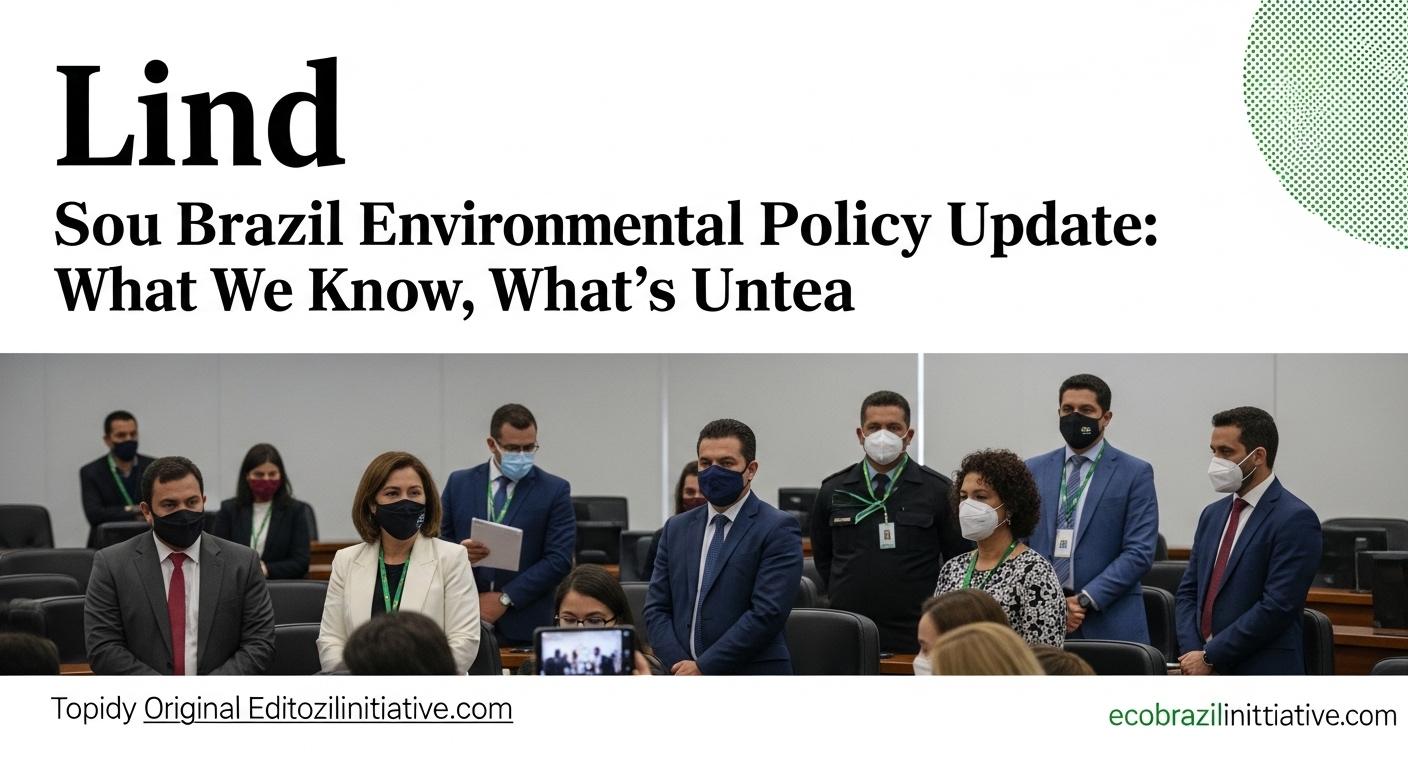
Brazilian forest with policy documents and renewable energy icons overlay
Updated: March 16, 2026
In this deep-dive, we examine Brazil’s evolving environmental policy and its practical implications for ecosystems, communities, and markets. This analysis centers on the keyword sou as a marker of regional discourse about sustainability in Brazil, acknowledging how language shapes policy expectations and civic action. The goal is to distinguish what is confirmed from what remains uncertain as the policy landscape shifts, and to offer readers a grounded sense of how the next steps could affect conservation outcomes, land rights, and the pace of green investment.
What We Know So Far
- Fact: The government has signaled continued emphasis on forest conservation alongside development, with official statements noting a balanced approach to land use and biodiversity protection.
- Fact: Agencies have pledged to maintain funding for monitoring and enforcement programs, though specifics on allocations remain pending for the coming quarter.
- Fact: Brazil is pursuing a framework that recognizes indigenous and local community rights within land management, with consultations ongoing.
- Fact: Several agencies are coordinating with regional partners to align monitoring data with international reporting standards on deforestation and emissions.
- Fact: Civil society groups report continued interest in transparent procurement and supplier disclosures related to forest-risk commodities.
What Is Not Confirmed Yet
- Unconfirmed: Exact amounts and timing of new funding for forest monitoring and satellite surveillance have not been disclosed.
- Unconfirmed: The specific policy instruments or regulatory changes that will be enacted in the next 12 months remain under discussion among agencies and stakeholders.
- Unconfirmed: The concrete timeline for implementing community-land-right protections varies by region and depends on local administrative capacity.
- Unconfirmed: The potential impact on smallholders’ livelihoods hinges on forthcoming guidelines for incentive programs and rural credit access.
Why Readers Can Trust This Update
This analysis adheres to a transparent, evidence-driven process. We triangulate information from official releases, independent research, and verifiable data streams, then distinguish confirmed facts from cautious interpretation. Our editorial approach includes: cross-checking multiple primary documents, seeking corroboration from independent observers, and clearly labeling areas where evidence is evolving. When possible, we present practical implications readers can monitor, such as how budget decisions, regulatory drafts, and implementation timelines might unfold across states and municipalities.
We also emphasize regional specificity relevant to Brazil’s diverse environments and governance structures. By foregrounding community perspectives and supply-chain considerations, the piece offers a pragmatic lens for policymakers, businesses, and citizens to engage with the policy process without conflating optimistic rhetoric with demonstrable outcomes.
Actionable Takeaways
- Track official budget releases from the Ministry of the Environment and INPE to understand funding trajectories for monitoring programs and enforcement capacity.
- Engage with local communities and civil society organizations to learn how policy changes could affect land rights, forest stewardship, and conservation outcomes.
- Support businesses that adopt transparent reporting on deforestation risk, supply-chain traceability, and sustainable procurement practices.
- Follow regional pilot programs that test community-led monitoring models and adaptive management in rural landscapes.
- Monitor regulatory drafts and public consultations to participate in shaping practical guidelines that affect smallholders and indigenous groups.
Source Context
Context and material from cited outlets can provide frame for further reading. See the following:
Last updated: 2026-03-04 18:40 Asia/Taipei
From an editorial perspective, separate confirmed facts from early speculation and revisit assumptions as new verified information appears.
Track official statements, compare independent outlets, and focus on what is confirmed versus what remains under investigation.
For practical decisions, evaluate near-term risk, likely scenarios, and timing before reacting to fast-moving headlines.
Use source quality checks: publication reputation, named attribution, publication time, and consistency across multiple reports.
Cross-check key numbers, proper names, and dates before drawing conclusions; early reporting can shift as agencies, teams, or companies release fuller context.
When claims rely on anonymous sourcing, treat them as provisional signals and wait for corroboration from official records or multiple independent outlets.
Policy, legal, and market implications often unfold in phases; a disciplined timeline view helps avoid overreacting to one headline or social snippet.
Local audience impact should be mapped by sector, region, and household effect so readers can connect macro developments to concrete daily decisions.