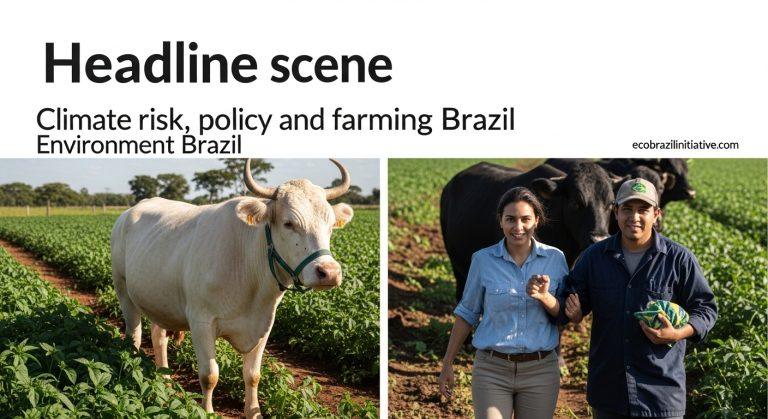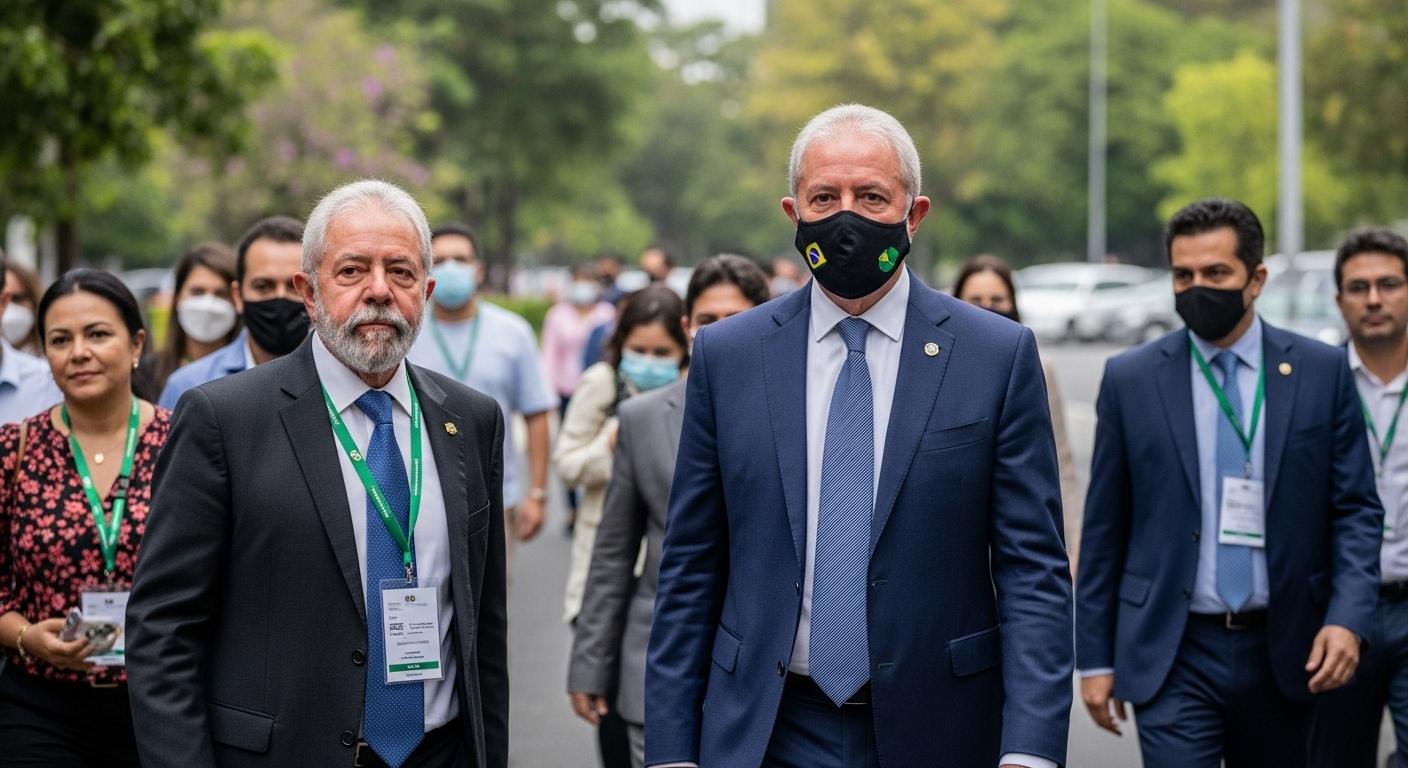
Editorial representation of Brazil's green investment landscape with forests and renewable energy infrastructure.
Updated: March 16, 2026
brazil Environment Brazil stands at a pivotal moment as Lula mobilizes billions for green investment, testing whether climate commitments translate into tangible gains for communities and ecosystems across the country. This article analyzes how funding streams, governance choices, and local conditions intersect to shape Brazil’s environmental trajectory in the Lula era, with a focus on practical consequences for industry, communities, and ecosystems.
Context and pressures shaping Brazil’s environmental agenda
Global climate finance has intensified scrutiny of how governments translate pledges into concrete action. In Brazil, the convergence of a new federal agenda, ambitious deforestation reduction targets, and a portfolio of sustainable-investment commitments creates a complex landscape. While reports indicate significant capital mobilization under Lula’s term—costing in the tens of billions of dollars—the real test lies in project pipeline, regulatory certainty, and timely disbursement. The country faces competing pressures: protecting expansive biomes such as the Amazon and Cerrado, while supporting rural livelihoods that depend on land use and agricultural value chains. The outcome will depend on policy coherence across ministries, transparent governance, and credible measurement of environmental and social benefits.
Historically, the success of large-scale green finance in Brazil has depended on bridging public goals with private sector confidence. Investors look for clear project pipelines, predictable public incentives, and robust risk management frameworks. In practice, this means aligning environmental safeguards with development priorities, ensuring land tenure clarity for communities, and mitigating local governance bottlenecks that can slow even well-funded initiatives. In this context, the Lula administration faces the challenge of translating macro-finance into micro-implementation, where the real environmental and social returns are realized on the ground.
Financing the green push: money, risk, and policy
The plan to mobilize substantial sustainable investments hinges on a blend of public finance, blended finance vehicles, and private capital attracted by credible pipelines. Sovereign green bonds, development-finance partnerships, and concessional lending are likely to be deployed to de-risk early-stage projects in forestry, biodiversity, energy transition, and sustainable agriculture. Yet several risk factors loom: currency volatility, political turnover, and execution risk in multi-stakeholder settings. To convert capital into results, policy design must create a pipeline of bankable projects, with clear environmental and social impact metrics, transparent procurement rules, and enforceable land-right covenants. An effective framework would also embed local benefits—jobs, skills training, and community ownership—so that investments translate into durable improvements rather than short-term spending.
Policy levers that can sharpen this push include streamlined permitting for green infrastructure, tax or subsidy structures that reward verified environmental outcomes, and strengthened carbon accounting to avoid double-counting or greenwashing. Importantly, finance will be most effective where it aligns with social outcomes and indigenous and local community rights, ensuring that benefits accrue equitably and risks are managed through inclusive governance. The balance between swift disbursement and rigorous safeguards will determine whether Brazil can sustain investor confidence over the long arc of the transition.
Implications for industry, communities, and ecosystems
Industrial sectors linked to land use and energy—such as agriculture, forestry, mining, and renewables—stand to gain from clearer rules and better access to capital. For communities, especially in rural and forested regions, green investments can bring improved health outcomes, local employment, and enhanced resilience to climate shocks. However, missteps—such as rushed land acquisitions, weak consultation processes, or inadequate benefit sharing—risk eroding trust and triggering opposition that can stall projects and undermine policy credibility. Ecosystem protection remains central: effective implementation can reduce deforestation, conserve biodiversity, and safeguard watershed services that underpin water security for urban and rural populations alike. The most successful path will be one that couples finance with participatory planning, ensuring that local voices help shape project design and monitoring.
Corporate actors and public agencies must navigate a mosaic of jurisdictions, from federal regulatory frameworks to state and municipal strategies. That requires interoperable data ecosystems, independent verification, and continuous learning from early pilots. If these conditions hold, Brazil can accelerate the transition to low-emission growth while strengthening rural economies and preserving ecological integrity. The risk is fragmentation—projects that are technically sound yet socially contentious or poorly coordinated—leading to delays and cost overruns that dilute the intended climate and development benefits.
Policy risk and scenario framing
Given the scale of the green investment push, policymakers face three plausible trajectories. In a best-case scenario, strong political will, coherent cross-ministerial alignment, and robust community engagement yield rapid project approvals, credible measurement, and steady capital inflows. In a moderate path, project pipelines advance unevenly, with pockets of success offset by bureaucratic hiccups and financing gaps, but overall momentum remains positive. In a worst-case scenario, governance bottlenecks, regulatory ambiguity, and social opposition undermine confidence, leading to delayed disbursements and underutilized funds. The realism of any scenario rests on three pillars: implementation capacity at the local level, credible environmental safeguards, and transparent accountability for results. Investors and communities should expect ongoing reform, but also vigilance to ensure that promises translate into durable, tangible gains.
To make policy risk manageable, the Lula administration could emphasize modular funding, phased project milestones, and independent impact verification. Building an explicit social license—through ongoing consultations, benefit-sharing agreements, and visible local co-benefits—will help align expectations and reduce resistance. Scenario planning, with concrete indicators for deforestation rates, biodiversity outcomes, and community well-being, can guide adaptive management as projects scale up. In the end, the degree to which Brazil translates lofty climate goals into everyday improvements will be judged by how well policy design, finance engineering, and community participation converge on the ground.
Actionable Takeaways
- Policymakers should prioritize clear, cross-ministerial roadmaps that align green finance with land rights, forest governance, and indigenous consultations to prevent bottlenecks.
- Investors need transparent project pipelines, verifiable impact metrics, and independent verification to build confidence in Brazil’s environmental finance opportunities.
- Local governments and communities should participate early in project design, ensure fair benefit sharing, and monitor outcomes to sustain social license and project viability.
- Public finance should use blended instruments and phased disbursements to de-risk private capital while maintaining rigorous safeguards and reporting.
- Continuous data sharing, open dashboards, and third-party auditing will help track progress, justify expenditures, and mitigate corruption or inefficiency risks.
Source Context
For background on the financing outlook and market sentiment surrounding Brazil’s green investment push, consider these sources: