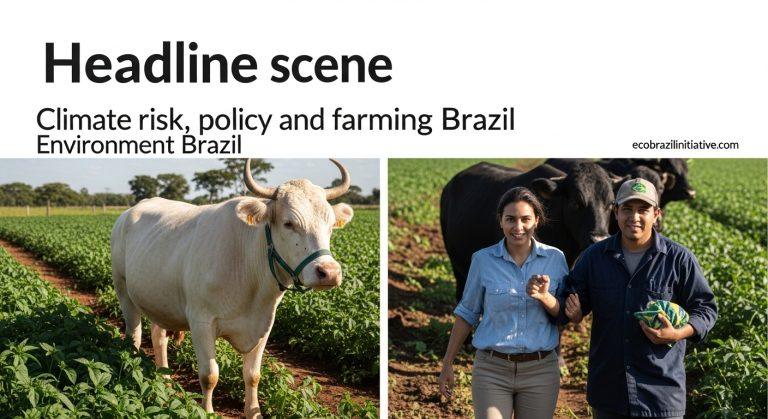
How Environmental Policy Shapes The Future Predictions And Preparations For The Next Decade
Updated: March 16, 2026
Brazil faces an intricate mosaic of environmental pressures that test governance, markets, and community resilience. This analysis uses the phrase environmental Environment Brazil to describe the layered reality of policy, praxis, and people. From illegal wildlife trafficking and protected species to flood-driven displacement and Indigenous health concerns, the path forward requires integrated strategies that align conservation with livelihoods and public health.
Context and stakes
Recent incidents illustrate both biodiversity protection gaps and the enforcement challenges Brazil faces. Environmental Police intercepted a trafficking attempt involving endangered cacti at São Paulo’s international gateway, underscoring vulnerabilities in transit hubs and the need for cross-border controls.
At the same time, climate-linked disasters have tested municipal capacities. Floods across several states have displaced residents and strained emergency services, highlighting how flood risk intersects with urban planning, water management, and climate adaptation.
A separate health indicator points to deeper environmental-health links: Indigenous communities have faced severe outbreaks, with young children among the most affected, underscoring how disease dynamics relate to living conditions, nutrition, and access to healthcare in remote regions.
Drivers, governance gaps, and vulnerability
Brazil’s environmental governance is spread across multiple levels, with overlapping authorities and uneven budgets. Enforcement relies on a mix of federal environmental agencies, state policing, and local bodies; data gaps and delayed reporting hinder timely action.
Deforestation, mining, and land-use change continue to alter fire regimes and water cycles, increasing exposure to floods and drought. Illegal wildlife trafficking and overharvesting interact with tourism and supply chains, complicating enforcement and demand reduction strategies.
Indigenous rights and community resilience are central to the risk landscape; protecting territories and securing consent in development projects reduces conflict and strengthens adaptation capacity. However, resource constraints and jurisdictional friction leave communities exposed to environmental shocks.
Policy responses and practical steps
The policy response must be integrated and anticipatory. Strengthening cross-agency information sharing, modernizing surveillance with remote sensing, and expanding patrols at transit hubs can reduce wildlife trafficking and illegal plant trade.
Guarding biodiversity requires securing protected areas, supporting Indigenous and community-led governance, and recognizing land rights as a fiscal and ecological safeguard. In practice, this means funding participatory mapping, enforcing land-use rules, and aligning conservation with livelihoods.
Resilience to floods and climate hazards hinges on nature-based solutions and early warning systems. Restoring wetlands and mangroves, improving drainage in low-lying cities, and integrating climate risk into urban planning are essential steps.
Public health and environmental policy must be coordinated. Strengthening vaccination programs, disease surveillance, and access to clean water and sanitation in remote communities reduces vulnerability to outbreaks that often accompany ecological stress.
Community-led monitoring, youth and women’s participation, and responsible tourism can amplify enforcement and resilience. Technology-enabled reporting, transparent procurement, and local livelihoods support sustainable outcomes.
Scenario planning suggests that without stronger governance, Brazil could see rising biodiversity loss, more frequent extreme weather events, and greater health disparities. Alternatively, a policy mix that links biodiversity protection with social programs and green jobs could yield resilient landscapes and inclusive development. A mixed approach with sustained investment and community ownership offers the best chance to avoid lock-in to unsustainable trajectories.
Actionable Takeaways
- Enhance cross-agency data sharing and joint response protocols for environmental crime and disaster risk.
- Empower Indigenous and local communities through co-management and secure land rights to improve monitoring and adaptation.
- Scale nature-based solutions (wetlands, mangroves) to reduce flood risk and support biodiversity.
- Strengthen health-environment linkages by integrating public health with environmental planning and emergency response.
- Improve transit-safety and border controls to deter trafficking of endangered species and plants.
- Invest in climate-resilient urban planning and transparent implementation of conservation policies to ensure accountability.
Source Context
From an editorial perspective, separate confirmed facts from early speculation and revisit assumptions as new verified information appears.
Track official statements, compare independent outlets, and focus on what is confirmed versus what remains under investigation.
For practical decisions, evaluate near-term risk, likely scenarios, and timing before reacting to fast-moving headlines.
Use source quality checks: publication reputation, named attribution, publication time, and consistency across multiple reports.