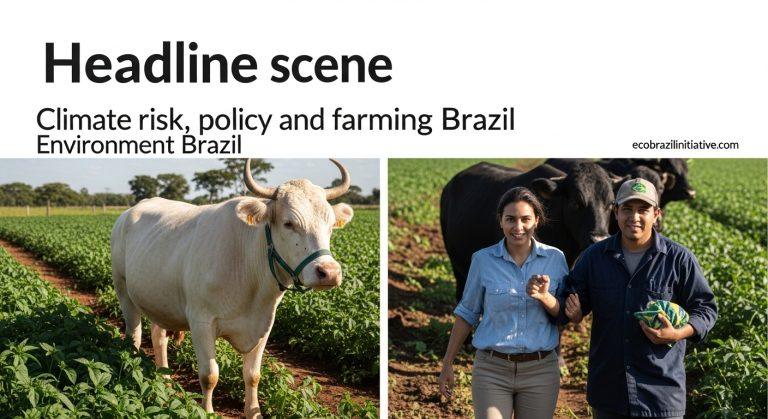
Documentary-style image of the Brazilian Amazon river with Indigenous communities and policy discussions.
Updated: March 16, 2026
In the evolving landscape of brazil Environment Brazil, policymakers, researchers, and Indigenous communities wrestle with how to balance development, conservation, and climate resilience. The recent reversal of a decree that would privatize three Amazonian rivers signals a testing ground for how Brazil might align economic interests with ecological safeguards, especially as droughts, floods, and deforestation pressures intensify in conversation with national and international markets.
Roots of the policy reversal
Background before the reversal involved a presidential or ministerial decree that would place river governance under private or mixed management. Indigenous and riverine communities argued that watercourses are a public resource with obligations to protect fragile ecosystems and the rights of local residents. Environmental advocates warned that privatizing river access and flow control could prioritize commercial extraction over long-term river health, often at the expense of communities living along the banks. The decision to retract or suspend the decree appears to be driven by protests, legal challenges, and a broader political signal that environmental governance must incorporate participatory processes and scientific safeguards. The move sits at the crossroads of land tenure debates, the preservation of biodiversity in the Amazon, and Brazil’s commitments to international climate and biodiversity frameworks.
Climate risks, river basins, and biodiversity
Brazil’s river basins are on the front line of climate volatility. Rainfall patterns in the Amazon and adjacent savannas have become less predictable, feeding floods in some regions while stressing others during drought periods. Experts emphasize that river management cannot ignore hydrological connectivity, sediment transport, and floodplain ecology, all of which influence fisheries, livelihoods, and Indigenous cultures. The privatization discourse, if revived, would have forced new governance compromises that could weaken ecological monitoring and long-term resilience. The current pause or reversal offers an opportunity to recalibrate policy around transparent risk assessments, independent monitoring, and adaptive management that keeps ecological thresholds at the center of decision-making.
Agriculture, land use, and market incentives
Brazil’s agricultural sector—especially soybean farming—remains a critical driver of both economic growth and environmental risk. Pressures to expand cultivation can collide with riverine and forest conservation, particularly where deforestation accelerates upstream sediment loads and downstream flood dynamics. At the same time, some farmers are pursuing green initiatives, including traceability programs, agroforestry pilots, and input-reduction strategies, which can align profitability with climate mitigation. The challenge lies in designing incentive structures that reward sustainable practices without penalizing smallholders or trapping communities in low-yield agriculture. This tension underscores the need for policy design that pairs enforcement with targeted support for sustainable livelihoods, rural development, and ecosystem restoration.
Paths forward: policy design and community engagement
Looking ahead, policy design should integrate river governance with ecosystem-based planning, climate resilience, and rights-based approaches. Effective pathways include co-management frameworks that elevate Indigenous and local voices, independent oversight of hydrological data, and clear benchmarks for ecological health. Cross-sector collaboration—between water, agriculture, and environment ministries—can help align river stewardship with food security and economic development. Finally, civil society and scientific communities must be empowered to participate in ongoing assessments, ensuring that adaptive policies reflect changing climates, new data, and evolving community needs.
Actionable Takeaways
- Anchor river governance in legally secure Indigenous and local land rights, with clear consent mechanisms for any management changes.
- Link river management decisions to robust environmental safeguards, independent monitoring, and public data transparency.
- Align agricultural subsidies and credit with sustainable practices, including agroforestry and reduced deforestation commitments.
- Invest in climate-resilient infrastructure and early warning systems to mitigate flood risks while protecting livelihoods.
- Promote inclusive policy design by ensuring consistent involvement of communities and civil society in decision processes.
- Foster regional collaboration on Amazon basin governance to address transboundary environmental and climate challenges.
Source Context
From an editorial perspective, separate confirmed facts from early speculation and revisit assumptions as new verified information appears.
Track official statements, compare independent outlets, and focus on what is confirmed versus what remains under investigation.
For practical decisions, evaluate near-term risk, likely scenarios, and timing before reacting to fast-moving headlines.