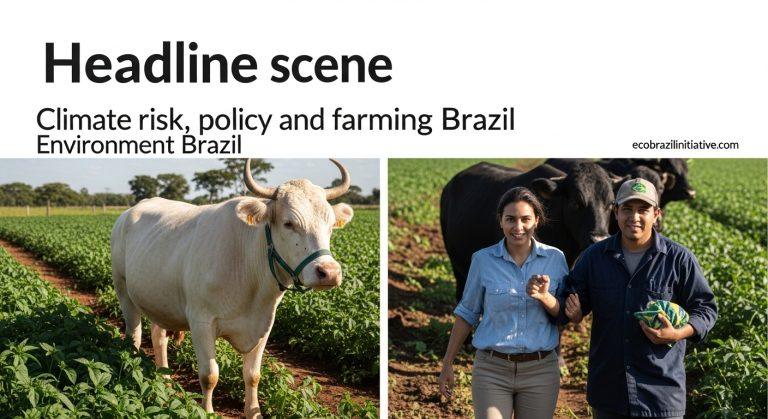
Brazilian landscape showing environmental resilience with forests, rivers, and renewable energy infrastructure.
Updated: March 16, 2026
Across Brazil, policy debates over how to balance growth with preservation have moved from the margins to the daily lives of farmers, urban residents, and investors. As climate hazards intensify, the country faces a moment when science, governance, and markets must align to protect forests, watersheds, and the communities that rely on them. This analysis considers brazil Environment Brazil as a dynamic, multi-layered challenge—one where national ambitions intersect with state actions, local knowledge, and global expectations—and asks what practical steps can turn ambition into durable outcomes for people and the planet.
Background and Context
Deforestation, biodiversity loss, and shifting rainfall patterns continue to shape the environmental frontier in the Amazon, Cerrado, and Atlantic Forest corridors. Observers note that forest cover acts as a climate regulator and a key source of livelihoods for rural families. Yet, policy gaps, enforcement challenges, and inconsistent funding create a safety margin for development projects that may undermine long-term resilience. For urban Brazil, climate hazards—flooding in megacities and heat stress in peri-urban zones—translate into higher costs for health, infrastructure, and social protection. Taken together, these dynamics highlight how environmental health and economic vitality are tightly coupled.
Brazil’s governance landscape mixes federal directives, state-level experimentation, and civil society watchdogs. Open data initiatives and independent research have improved transparency, but practitioners warn that delays in data updating, uneven geographic coverage, and uneven capacity across municipalities compromise rapid decision-making. In this context, the push toward more reliable monitoring—whether through satellite imagery, ground-truthing programs, or interoperable datasets—appears less like a luxury and more like a prerequisite for credible climate policy and investor confidence.
Policy and Governance
Policy architecture in Brazil now sits at a crossroads between ambitious climate commitments and the political realities of federalism. Advocates argue for stronger alignment across ministries, clearer targets for emissions, deforestation, and water stewardship, and a governance model that rewards preventive action rather than reactive restoration. A notable development is the rise of free, publicly accessible platforms that consolidate government data to assess compliance with international rules such as the European Union’s EUDR, which aims to curb imports linked to deforestation. While these tools support accountability, analysts caution that data quality, timeliness, and interpretation matter as much as access. The result is a policy environment that rewards evidence-based decision-making but requires sustained funding, technical capacity, and cross-border cooperation to be effective.
Economic and Social Dimensions
The economic calculus around environment in Brazil is evolving toward what supporters call a green-growth model. Soy farmers, cattle producers, and smallholders face a tense trade-off: expand production to meet global demand, or invest in practices that reduce emissions and boost resilience but may require upfront costs and market retooling. Green initiatives—cover crops, soil restoration, integrated pest management, and agroforestry—offer potential benefits in productivity, soil health, and risk management. Yet implementation hinges on access to credit, technical extension, reliable markets, and transparent certification schemes that can capture premium prices without leaving small producers behind. In urban areas, climate adaptation translates into smarter drainage systems, nature-based solutions, and inclusive planning that protects vulnerable communities while supporting local jobs.
Actionable Takeaways
- Strengthen federal-state coordination; align targets; invest in monitoring and verification capabilities across regions.
- Scale transparent data-sharing; ensure timeliness and interoperability to support rapid decision-making in disasters and droughts.
- Invest in adaptation for vulnerable communities; expand social protection measures linked to climate risk and housing resilience.
- Support farmers with incentives for sustainable practices; provide credit, insurance, and extension services that reward agroforestry and soil health.
- Integrate EUDR considerations into national trade policy and domestic supply chains to reduce deforestation-linked risk for exporters.
- Promote nature-based solutions and green infrastructure in cities and rural areas to improve flood control and biodiversity co-benefits.
- Encourage transparent certification and market access for smallholders to ensure fair prices and traceability across commodity chains.
Source Context
Context and further reading through recent coverage:
- Mongabay: Free platform tracks EUDR compliance using government data
- Reuters: Flood toll rises in Brazil as rains test flood-prone regions
- Fine Day 102.3: Brazilian Soy Farmers and Climate Initiatives
From an editorial perspective, separate confirmed facts from early speculation and revisit assumptions as new verified information appears.